
We stabilise your foundation before and during basement works to protect your home and keep approvals on track. Call 1300 970 930 to speak with Chris about a free no‑obligation structural assessment.
We are Underpinning Sydney, structural preservation specialists with 20+ years’ experience. Our licensed, insured team uses council‑compliant methods and tight‑access equipment to limit disruption to your sydney home.
Our process includes concrete underpinning, screw piling, targeted resin injection and coordinated engineering reports. We use hydraulic jacks, laser levelling and vacuum excavators to work safely near services and preserve the existing foundation.
We provide clear fixed‑price quotes, honest assessments and permanent solutions that protect property value.
Key Takeaways
- Safety first: we stabilise the foundation to protect your home during works.
- Licensed, insured team with 20+ years’ experience and council‑compliant methods.
- We recommend the right underpinning method based on engineering advice.
- Tight‑access gear and precision tools minimise disruption to your property.
- Free initial assessment and coordination of structural reports for smooth approvals.
- Call 1300 970 930 to speak to Chris and book an inspection.
Structural preservation for Sydney basement projects — safe foundations, compliant outcomes
We deliver certified preservation works that protect homes and keep your project compliant and on schedule.
We protect your foundation with engineered solutions and plain‑language advice. Our process follows local council rules and includes permits, noise and dust control and waste recycling.
We stage every job to maintain support at all times. Our team uses equipment suited to tight urban areas and heritage sites across Greater Sydney.
- Preserve structure: keep the existing foundations safe while new usable space is created.
- Certified steps: engineering sign‑off and documented certification at each stage.
- Clear guidance: plain advice on options, risks and long‑term durability.
- Coordinated approach: we work with your engineer and builder to control program and quality.
Ask our team about soil types and regional considerations, from Inner West clays to Northern Beaches sands.
When your Sydney home may need underpinning before or during basement excavation
When your house shows movement, prompt assessment helps avoid larger damage. We identify clear signs and explain the risks so you can choose a safe, engineered path forward.
Visible warning signs: wall cracks, jammed doors and uneven floors
Look for stepped cracks in walls, sticking doors and windows, sloping floors and gaps at skirtings. These signs often show ongoing movement and emerging structural damage.
Risks from adjacent digging, weak soils and added building loads
Neighbouring excavation, compressible soils and high groundwater can trigger settlement. Increased loads from renovation works or new garage slabs may exceed the original design.
Basement use-cases that trigger load changes: garages, living areas and storage
We reassure homeowners by recommending early assessment, temporary shoring or staged works when needed. Where required, underpinning transfers the load to deeper, competent strata and can include jacking settled structures.
- Check now: cracks, sloping floor, gaps at skirting.
- Heritage and terrace party walls are vulnerable to nearby digging.
- Prior leaks or poor drainage often precede foundation distress.
- Email photos for a free preliminary assessment and next-step guidance via project review.
Our council-compliant process: from honest assessment to certified handover
We start every job with a straight‑forward photo review and on‑site check to set a safe baseline.

Free no‑obligation structural assessment and photo review
Begin with a free photo review and an on‑site structural assessment when needed. This gives clear advice and a documented snapshot of existing conditions.
Engineering report coordination and method selection
We organise the engineering report and select the safest, most cost‑effective methods for your foundations. Our team works with your engineer to define scope and expected outcomes.
Staged works with laser levelling, monitoring and minimal disruption
Work is staged so support remains in place while excavation progresses. Laser levelling and crack monitoring track any movement and guide decision making.
We use tight‑access machinery, conveyor soil removal and vacuum excavation near utilities to reduce risk and keep the site tidy.
Certification, documentation and peace of mind for your property
You receive a fixed‑price quote with a clear scope, stages and inclusions. At completion we provide certification, full documentation and maintenance guidance.
We keep your project on schedule with clear communication at each milestone. Speak with Chris on 1300 970 930 to book an inspection.
Underpinning techniques matched to Sydney soils and structures
Matching method to site conditions is the key to lasting structural stability and council compliance. We assess soil type, existing footings and the expected load before recommending an approach.
Mass concrete and beam-and-base to transfer load to competent soil
Traditional mass concrete deepens footings and gives an inert, permanent support. Beam-and-base systems spread the load across stronger soil to limit settlement.
When to use it: where access allows and durability is critical. Core drilling and concrete pours create new pads and continuous support.
Screw piling and mini-piles: steel solutions for deeper bearing
Screw piles and mini-piles use steel shafts to reach firm strata. They transfer load to deeper bearing layers and can be jacked to re-level footings under engineering control.
This option suits tight sites and wet soils where long-term steel support is preferred.
Resin injection: where foam fits, and its limitations
Polyurethane resin can fill voids and lift slabs quickly. It is fast and low‑disruption but may shrink or migrate along weak paths and can risk over‑lifting.
We outline limits up-front and favour concrete or steel when permanence and council certification are required. All works are engineered, monitored and documented to protect your structure and program.
- We match techniques to local soils, groundwater and access constraints.
- Hydraulic jacks allow controlled lifts under engineer supervision.
- Where durability matters, we recommend concrete or steel over foam.
Specialised tight‑access equipment for safe basement excavation and underpinning
Small, powerful plant lets us work beneath existing homes without major disruption. We choose machines that fit tight subfloor spaces and reduce noise.
Mini and remote‑controlled excavators, compact skid steers and conveyor soil removal
Mini and remote‑controlled excavators let us dig safely where access is limited. Compact skid steers and conveyor belts remove spoil quickly.
Key benefits:
- Mini excavators access tight zones and cut risk during excavation.
- Conveyors and skid steers speed spoil removal from beneath the building.
- Site controls limit noise, dust and neighbour impact.
Hydraulic jacks, core drilling and concrete pumps for accurate, clean work
Hydraulic jacks give controlled lifts under engineer supervision. Core drilling creates precise openings in footings and walls.
Concrete pumps place mixes cleanly with minimal access impact. This keeps the structure stable and the site tidy.
Laser levelling and vacuum excavation near services to protect existing structure
Laser levelling provides accurate benchmarks and continuous checks during work. Vacuum excavation protects services and reduces strike risk.
- Laser levelling ensures exact alignment and quick quality checks.
- Vacuum systems safely expose services close to the building.
- We tailor equipment and solutions to access, soil and structural constraints.
Using the right equipment shortens program time and cuts disruption. We bring tested machines and safe practices to every project.
Managing water, retaining walls and subfloor environments beneath existing homes
Managing subsurface water and enclosed subfloor air is essential to long‑term stability and indoor health.
We assess groundwater and design de‑watering systems to keep work areas safe and dry. Sump pumps, waterproof membranes and French drains control water entry and reduce ongoing moisture.
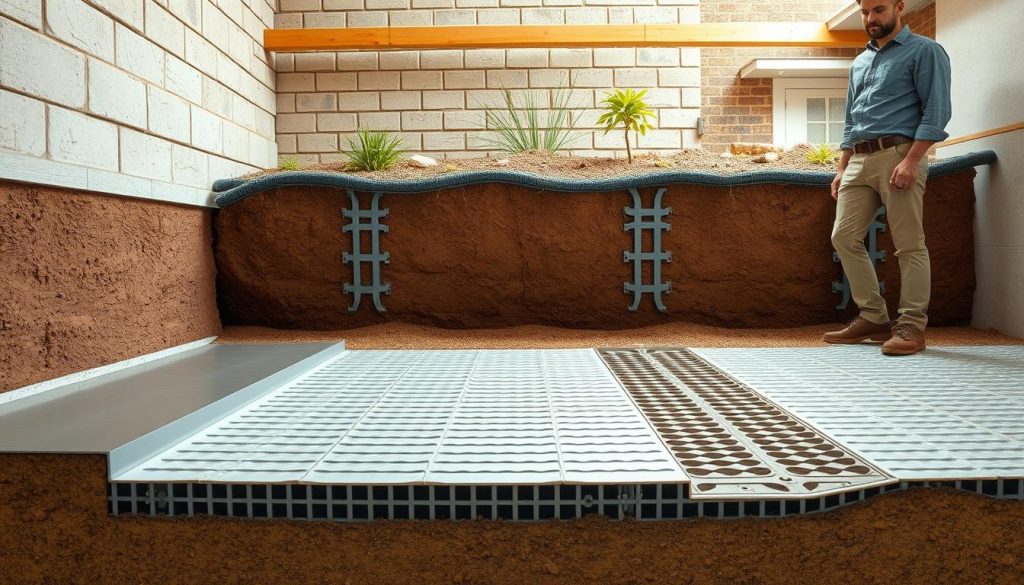
Groundwater control: sump pumps, membranes and moisture management
We install sump systems, membranes and sealants to manage persistent water and soil moisture. This lowers risk to the foundation and timber.
Retaining wall design, steel/timber support and integrated drainage
Retaining walls use concrete, stone or timber with back‑of‑wall drainage and filter media. Temporary steel or timber supports protect walls during staged works.
Subfloor ventilation and drainage solutions to prevent future movement
Ventilation, ag drains and downpipe discharge prevent damp and mould. Correct drainage reduces seasonal soil changes and future movement.
We document every systemso you have maintenance steps and council‑compliant records.This protects health and structural value.
| Issue | Typical solution | Benefit |
|---|---|---|
| Groundwater seepage | Sump pump + French drain | Dry subfloor; less water damage |
| Backfill drainage | Filter media + ag drain | Reduced hydrostatic pressure on walls |
| Subfloor damp | Moisture barrier + ventilation | Lower mould risk; stable foundation |
What it costs, how long it takes and how we minimise disruption
We give clear cost and timing guidance so you can plan with confidence. You get a fixed‑price quote and a staged schedule that spells out inclusions and exclusions.
Transparent fixed‑price quotes and scheduling
You receive a transparent fixed‑price quote with clear inclusions, exclusions and a simple schedule. We coordinate engineering, deliveries and council windows to reduce delays.
Timeframes by method, soil and scope — from days to several weeks
Small traditional pins can be completed in a few days. Larger beam‑and‑base or piling works typically run over several weeks.
- We outline realistic timeframes by method and soil so you can plan the rest of your project.
- Tight‑access equipment and conveyors cut handling time and site impact.
- We sequence works to keep essential services operating where possible.
- Daily housekeeping, noise management and coordinated pours reduce neighbour disruption.
- Our solutions focus on safety while maintaining access throughout projects.
Call 1300 970 930 to book today and discuss options and realistic program windows. With 20+ years’ experience we deliver projects on time with fewer surprises.
Underpinning for basement excavation Sydney
Licensed specialists work with you to protect your property and avoid unnecessary work. We combine clear advice with certified methods so you only get the work you truly need.
20+ years’ experience, licensed & insured team
We have 20+ years stabilising foundations across Greater Sydney. Our licensed, insured team delivers engineered, certified outcomes and practical guidance.
Services across Greater Sydney: houses, terraces and complex sites
We serve houses, terraces, heritage structures and mixed‑soil properties in many areas. Work is staged in confined city sites using tight‑access equipment and strict OH&S controls.
- Concrete underpinning, screw piling, resin injection and crack repairs.
- Coverage across Inner West, Eastern Suburbs, North Shore, Northern Beaches and nearby areas.
- We coordinate engineering, permits and approvals to streamline delivery.
- Expert supervisors on site to ensure quality, dust/noise control and waste recycling.
Honest advice, no upsell. Call 1300 970 930 to speak with Chris and book an inspection. Email site photos for a fast preliminary review of your property.
Conclusion
Permanent foundation solutions merge concrete, steel and site‑specific design to protect your property.
We design underpinning that keeps your home safe during any excavation and beyond. Our methods use mass concrete, beam‑and‑base and screw piles matched to local soils and groundwater.
Tight‑access equipment, laser levelling and vacuum excavation protect services and footings. Integrated drainage and ventilation reduce future movement and water damage.
You deserve a safe, compliant outcome with minimal disruption. Call 1300 970 930 to speak to Chris, book a site inspection or email photos. Learn about targeted resin options at polyurethane soil injection today.